Blog of Ewa Bartosiewicz

Category: Here and now (Page 1 of 2)

Poverty is a state of mind

The dust has already settled after the Wojewódzki scandal in Poland, when Julia Wieniawa agreed with the thesis that poverty is a state of mind. This drama caused such public outrage that it went beyond the celebrity bubble. Meanwhile, Pope Leo XIV himself seemed to respond to Julia by writing in his first exhortation, Dilexi Te: “Poverty is not a choice. Yet there are still those who dare to say so, showing blindness and cruelty.” (DT 14) It seems obvious that thinking about money will not make a person richer, but could it be that there is something to this controversial thesis after all?

What if we were to say that “slavery is a state of mind”? Externally, of course, we cannot break the chains that bind us with the power of our thoughts, but that does not mean that we have ceased to be internally free. In his memoirs from the Auschwitz camp, Viktor Frankl writes that you can take everything away from a person, but you cannot take away their ability to choose how to act. In any situation, you can be noble or despicable. One can rise above the surrounding reality, as demonstrated by prisoners who encouraged others and gave away their last piece of bread to save someone’s life. However, one can also be drawn into the abyss of cruelty and, as a fellow prisoner, prove to be more ruthless than many SS officers. This decision, made in a moment of extreme circumstances, will be influenced by a series of events in our lives, but it is precisely then that the pinnacle of our humanity can reveal itself. It is no different in everyday life, when we can take full advantage of our freedom and do the right thing, or we can succumb to the expectations of others, our own fears or desires, and ultimately do the wrong thing.

So, can’t poverty also be a state of mind? Wouldn’t we agree with Bob Marley when he said, “Some people are so poor they only have money”? Will not those who had little on earth, because they stored up treasures in Heaven, turn out to be truly rich one day? Again, it is worth looking more at what is happening in our hearts than at the external state of our wallets. After all, there may be a millionaire who is completely free with his millions, while someone else may be so attached to his only coffee mug that he is willing to kill for it. However, practice shows that the more you have, the more difficult it is to distance yourself from money. Jesus himself says that “it is easier for a camel to go through the eye of a needle than for a rich man to enter the kingdom of God” (Luke 18:25). Therefore, blessed are the poor in spirit, that is, those who are free in relation to what they have and remember that everything is a grace and a gift from the Lord. Pope Leo, quoting John Chrysostom and St. Ambrose, reminds us that “not to share one’s goods with the poor is to steal from them and deprive them of life. The goods we possess are not ours, but theirs. (…) You are not giving the poor man something of your own, but returning to him what is his property. For you are only appropriating for yourself what belongs to everyone” (DT 42-43).

When we ourselves have plenty, it is easy to close ourselves in our own world and not notice that, in fact, nothing belongs to us. “It must be said that we have developed in many ways, but we are illiterate in accompanying, caring for, and supporting the weakest and most vulnerable in our developed societies. We have become accustomed to looking away, to passing by, to ignoring situations unless they directly affect us” (Fratelli Tutti 64) That is why, from time to time, I examine my conscience and wonder how it is possible that I live here peacefully and lack nothing, while so many people do not have enough to feed their families or work only to survive. I look around me for Lazaruses waiting for crumbs from my feast, but I often catch myself thinking in a way that suggests that I have honestly earned my money and that I deserve to do with it whatever I please.

However, it seems that sharing material goods is not yet the most important lesson to be learned. There is also the one of not looking down on others. Pope Leo, referring to many saints, notes that “each of them discovered in their own way that the poorest are not only the object of our compassion, but also teachers of the Gospel. It is not a matter of “bringing” God to them, but of meeting Him with them. All these examples teach us that service to the poor is not a gesture made “from above to below,” but an encounter between equals, where Christ is revealed and adored.” (DT 79) The third lesson to be learned is even more difficult. I recently heard that what distinguished the Samaritan from the priest and the Levite was that he had time. In a life carefuly planned out in a calendar, there is simply no room to love those who need us. Jesus repeatedly showed that He was in no hurry. If He had time, why shouldn’t I? Is what I have to do really so incredibly important and necessary that there is no time for my neighbour? Truly poor is the person who is too busy to have time for what is really important. So it is a state of mind. There is no doubt about it.

Longing for silence

Our world has become filled to the brim with words. Often too many, for they can hurt, judge, and divide. We are surrounded by a constant avalanche of commentary, opinions, analyses or observations and only some of them are uplifting and inspiring. Given that everyone today has the possibility of unlimited expression, I feel like simply remaining silent on every topic. I often ask myself, “why would I write?” when everything has already been written. Perhaps only to create art, to express admiration, to name beauty, somehow like painting a picture?

At the end of my summer holidays, on a long car trip, I listened to the audiobook “Światłoczułość” by Jakub Jarno (not translated into English yet). The positive reviews of this book are not exaggerated, because the author truly captures reality with so much passion. Moreover, it’s an incredibly difficult and cruel reality of war times. But still you read it with curiosity, noticing the light, celebrating the digressions and vivid descriptions, feeling that there is something more in all the places where looking on the surface you only see death. It’s good that someone can still compose a feast out of letters and sentences, analogies and meanings. So I, too, have longed to write, though it’s difficult in a world drowned in an overabundance of words.

Life today is starting to demand silence from us in a much louder manner and a pause in the whirlwind of overstimulation, but at the same time, it invites us to fill that silence with content, meaning, and hope. Today, when, after a month of school madness, my body decided to rebel and postpone my numerous weekend plans, I’m immersing myself in the silence and recalling a time of contemplation amidst the Masurian nature. I thought then, among other things, that all the happiness in the world can be contained in simple gestures, ordinary presence, and small joys. It doesn’t take many words at all.

Final “yes”

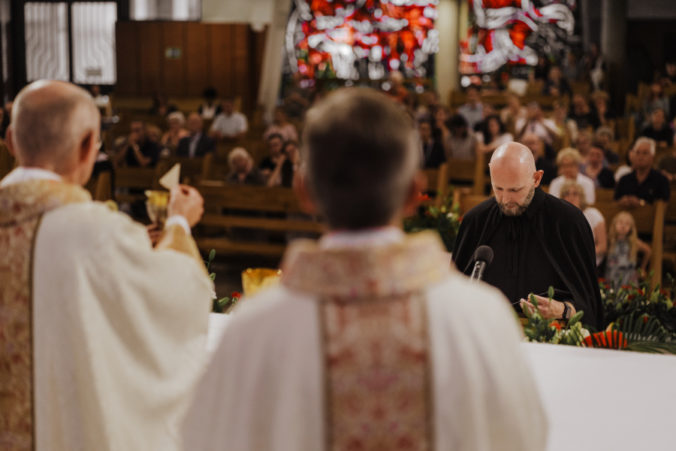
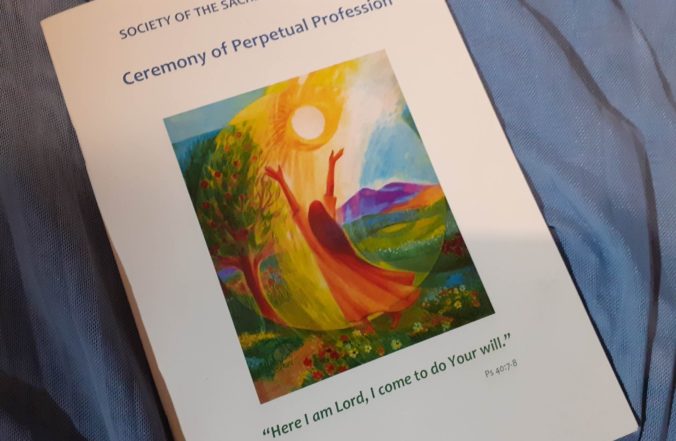
Yesterday I had the opportunity to witness again the moment when a close Jesuit said his final “yes” to God (for the second time, because he already made his perpetual vows in the novitiate). During the ceremony, Romek decided to break some convenances and said a few words of his own after the Gospel, many of which reminded me of what is important, what gives life and what burns up the heart.

First, he told us about a dream he had a few years ago, in which he discovered three important rules of life: love people, trust life and live through everything. Even though I had heard this story before, the words about trust resonated strongly within me. God is constantly calling me to trust the journey and the process, and I am still impatient. I would like to know the plan and see the goal on the horizon. During my last retreat, this truth about trusting life came to me in the form of words from a song by Dream Theater: “let the story guide me”. So the story goes on and takes me forward step by step.

A large part of the sermon was filled with Romek’s understanding of the vows, which he was soon to renew in front of everyone, before the Eucharistic Jesus. This understanding is very close to my heart and reminds me that although my vows expired over two years ago, I still want to live them with all my heart here and now, where God has placed me.

Chastity is loving people in deep relationships, without fear, without faking, without selfishness, it means constantly expanding your heart and learning to be for others. Obedience is trusting that God works in the sinful Church, it means freedom to stick to His plan and not your own ideas, it means brotherhood and conscious cultivation of small gestures of love despite various prejudices. Poverty is accepting yourself and others in your greatest weakness, allowing yourself to be dependent and vulnerable, it means simplicity on many different levels.

These three rules of the Gospel are for everyone who wants to follow Jesus, because, as Romek put it: to say “yes” to Him is to say “yes” to life within yourself and to let this life flow into the world. One sentence especially resonates with me today: “When I think about Him, everything in me is deeply moved.” I can relate to this. So it is.

You can listen to the entire ceremony here (with English translation!).
Photo by Asia Wiśniewska. More photos here.

Life without illusion

I was in Rome over the weekend and a lot of beautiful things happened there! First, of course, my friend Ala’s final vows, which I attended. A lot of joy and emotions, the power of the Word and the multicultural community. I love accompanying people in their “yes” forever, because it’s an amazing moment! I also feel the responsibility of being a witness to this public obligation. After all, it should be the closest people who we are able to count on when fighting for fidelity in our vocation during a crisis – be it marriage, priesthood, consecration or any other form of giving our lives to people and God. This is why we are a community, to support each other on the way.

This time, being in Rome, I had the opportunity to see the rooms of Ignatius Loyola for the first time (thanks, Dominik!), where the founder of the Jesuits spent many years of his life and where he died. There’s always something special about touching history that changed my life hundreds of years later. With gratitude, I later also visited the church dedicated to him on the Campus Martius. A tourist attraction in this place are the frescoes made by an Italian artist, also a Jesuit, Andrea del Pozzo. The craftsmanship of these works lies in the fact that they perfectly show the illusion of three-dimensionality. We have the impression that the painted figures are sculptures coming out of the walls, and the ceiling is higher than it really is. We can even admire a large dome that is not there, but standing in the right place, we can be absolutely convinced that it is so much there and looks great.

We have an infinite number of illusions that we succumb to every day. In a world where artificial intelligence can create a perfect imitation of reality, soon we will not be able to distinguish truth from falsehood. However, it is much more difficult for us to get rid of the illusions we have about others and ourselves. Aren’t they the cause of most of our crises? We say to ourselves: ” But we were hoping!” and we lose strength to fight for what was so alive when we said our “yes”. Jesus is the master of freeing us from all illusions. He never promised that it would be easy and pleasant, on the contrary – persecution, cross, pain and tears. At the same time, in the midst of all this, a happiness so great that one cannot imagine a greater one – as witnessed by these 7 women who on Saturday vowed obedience, poverty and chastity to Him.

In today’s Gospel, speaking to the Jews, Jesus says: “You will know the truth and the truth will set you free.” It is not any illusions that will give us happiness, but only the honest truth – sometimes painful and hard. However, how difficult it is to allow yourself to see this truth (especially about yourself). It is much easier, like the Jews, to be convinced that we are already free, so we do not need the truth.

How do we protect ourselves from illusions? As for frescoes, just stand slightly to the side. Then it is clear that what we are looking at is just a carefully prepared trap for the brain. A change of perspective also helps in the case of other illusions, and that’s why we are a community, to pull each other out of them and make our vision of the world real. Only those who can listen to others and look at things from many different angles will be able to grasp the truth which surely sets us free.


p.s. for those interested in optical illusions, a great video about it: https://www.youtube.com/watch?v=dBap_Lp-0oc

About those, who looked up

Recently, unbelievably many of my close and distant friends have started recommending a movie on Netflix. At the moment when comments began to appear in most of the media, and I was already afraid to open the fridge and see the words “Don’t look up” there, some of my favourite Youtubers referred to the film in yesterday and read a review by Michał Oleszczyk: ” This is a film born of pride and superiority, written with a pickaxe and directed with a jackhammer. ” After that, I already knew that I had to watch and form my own opinion.

Regardless of the ideological intentions of the creators, it seems that they very accurately diagnosed the state of modern society. Looking at successive exaggerated, grotesque attitudes of the characters (played by the best actors in the world), I realized many times that not only are they pleasable, but that they are happening just before our eyes. I think the world might react exactly as in the movie to the information that we will all die soon. This arouses a longing for the common good and solidarity to be able to stand above politics and “business as usual”, but the fact that it will not be so does not mean that nothing can be done. And I am not referring to the ecological crisis, but to our usual everyday life, in which we often feel powerless in the face of decisions made somewhere above. Maybe it is enough for each of us to be guided by what is deep in our hearts?

2,000 years ago, some magi, who we would rather call scientists today, also spotted an unusual astronomical phenomenon in the sky. They didn’t talk about it on TV or on social media, but went on the road taking myrrh, incense and gold with them. In the background there is also great politics and Herod trying to stay in power. Little is known about those who visited baby Jesus in Bethlehem. We don’t know how many there were – it could have been three, but it might as well have been a bunch of people with three gifts. We don’t know exactly where they came from, but we do know that they were not Jews, so they did not expect the Messiah at all. So why did they decide to walk a long way to meet a newborn baby in a small village on the outskirts of the Roman Empire? Maybe they were driven by curiosity, maybe a desire for adventure, or maybe they just had a deep conviction in their heart that this was what they should do. They were looking for nothing pious, yet they found God.

If I were to look for a moral in the movie “Don’t Look Up”, it would be: “Do what you can and live as if today was the end of the world”. Absolutely nothing revealing, yet still true and up to date. The words of the only believer in the film remained in my head: “If God wanted to destroy the Earth, He would destroy it.” He would have many reasons to do so, but apparently He is still giving each of us time to convert. Maybe it is worth spending this time with those we care about and doing what we love? Banality. But I guess still relevant.

The grace of darkness

In my Advent this year, so far I find much more darkness than light. Maybe this will make the experience of Israel waiting for the Messiah a little closer to me. When lack of strength and hope creeps into life, longing becomes natural. You want to cry to God that salvation may come at last. He always responds to that call, but almost always quite differently than we might expect.
One of the small joys that I have at this time is checking my advent tea calendar every day, where I find not only inspirations of tastes, but also sometimes spiritual ones. One day, seeing the tea called “Arctic Fire”, I immediately thought of paradoxes about God: power in weakness, life in death, infinity in limitations … It was only recently in a lecture on Christology that I learned that it is actually called “sub contrario “- bordering on contradiction . These contradictions, however, only arise in our limited human thinking. Everything is coherent and inclusive for God. There is already light in the darkness.

On the same day, I read the words of Tomas Merton:

“When the time comes to enter the darkness in which we are naked and helpless and alone; in which we see the insufficiency of our greatest strength and the hollowness of our strongest virtue; in which we have nothing to rely on, and nothing in our nature to support us, and nothing in the world to guide us or give us light—then we find out whether or not we walk by faith.”

Now it was all clear. Darkness is grace.

The scent of Advent

One of the most important passages in the Gospel for me is the anointment in Bethany. Mary breaks a bottle of precious Nard oil and its scent fills the whole house. This fragrance accompanies me every year during the Holy Week, because a creative Franciscan priest from Poznań once decided to give all participants of the liturgy a tiny vial of real nard, and since then I always solemnly open it on Holy Monday. This scene was also the subject of my contemplation at this year’s retreat and made me realise how much I have recently focused on caring for the bottle, and not for the precious oil inside. It was then that I desired the experience of Paschal fragrance to spread over more of my life.
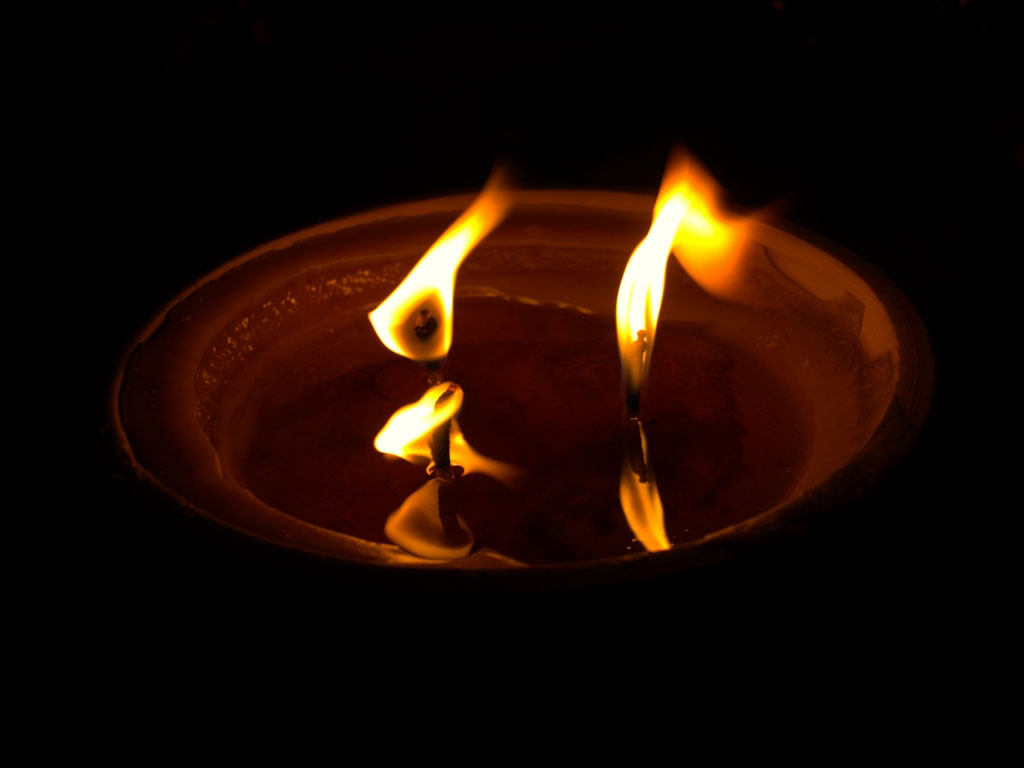
Recently I realised that Advent also has its fragrances. The smell of incense and candles, orange and cinnamon, pine needles and hay, honey and ginger, frosty air in the morning … These are not the smells that accompanied Jesus during His birth (maybe apart from the hay ;)), but they are the smells that correspond with the time of waiting for Him to come back. They express a longing for warmth, for the sun, for closeness. They make life brighter on these gloomy days.

Earlier this year, I was inspired to pray with the book “Touch, Feel, Taste” by Ginny Kubitz Moyer, which offers simple prayers based on all 5 senses. When my head was full of different thoughts, I needed an encounter with God that would involve my body and allow me to experience a God who transcends what is logical and understandable, penetrating everything with His Presence. On the threshold of this year’s Advent, this thought came back to me, especially in terms of fragrances. They have been with me for some time thanks to the aromatherapy diffuser that I received from my students and which immediately caught on in my everyday life, relaxing my shattered nerves in a bit of cedar, rosewood and marjoram. There is also raspberry seed oil on my cupboard and lavender bath salt in the bathroom. At the desk, an Advent calendar with teas inside, waiting to be opened (brilliant idea!), so that my home can fill up with new fragrances that stimulate the senses and open up the soul.

There is something about smells that makes it possible for us to remember the circumstances in which we smelt something for many years. They can also clearly influence our mood and are literally responsible for the fact that life has a taste (maybe it is worth appreciating at a time when many people have lost their sense of smell and taste, at least for a moment). Fragrances also have a special property – they quickly reveal the company we have spent our time with. Pope Francis said that it would be good for the shepherds to smell like their sheep. I think it would be very good if each of us would be filled with the scent of God. May this be our Advent experience.

In the end it doesn’t even matter

This year, for the first time in 11 years, during this November time, I visited the graves of my relatives in my home region. Well-known cemeteries with a thousand lights make an impression and provoke reflection on life and death.
I visited a friend of mine from elementary school, who was severely depressed in high school and committed suicide in her freshman year. I visited the vice-principal of my high school, who died on the day when he was supposed to be on the board of my oral Polish baccalaureate exam. I visited my Grandma, who passed away 2 years ago when I had definitely too many difficult goodbyes in one week. Each of these people and each of these deaths somehow influenced me and broadened my horizon of thinking. Over the last few weeks, I have been drowning in a sea of ​​small things to do, tests to be checked, lessons to be prepared, and tasks to be checked off my list. I desperately need a change of perspective and a constant reminder of what is really important. When looking at the end of life, questions arise about what is worth living for and what would be worth dying for.

At one of the cemeteries in Białystok, we found a piece of paper surrounded by a handful of candles. It read: “Victims of the humanitarian crisis at the border.” Is putting my own candle there really the only thing I can do? Am I sure that I couldn’t have done more? My conscience bothers me when I think about someone dying pointlessly. Because of political games, because of a drunk driver, because of a madman with a gun in his hand, because of war, because of a pandemic… Could it have been avoided? I can’t save everyone, but haven’t I neglected the opportunity to save anyone at all?

A song from many years ago came back to me.

I tried so hard
And got so far
But in the end
It doesn’t even matter
I had to fall
To lose it all
But in the end
It doesn’t even matter

In the end, nothing will matter. Only if I proved to be human at the right moment.

To act or to pray?

Maria and Martha. Contemplation and action. It is difficult to remain indifferent to today’s Gospel. Many times for me it was a remorse: “I should pray more.” Today I am convinced that this conclusion is not always appropriate. I think the best part Mary has chosen is not just that she listened to Jesus instead of running around the house, and Martha’s mistake was not at all that she worked too much and didn’t have time to sit at the Master’s feet.

The key to this story may be Martha’s attitude and the fact that she has taken the worst part by far. She decided not only to do what she clearly did not enjoy, but also tried to force others to do so, causing them to feel guilty. Don’t we all know such attitudes? I have met many people in my life who have done a lot, but it did not give them life at all, only bitterness. However, with great determination they tried to convince the whole world that this was what they had to do and looked down on those who had chosen a different path. I have also met people who were convinced that intense action is wrong because it always leads to empty activism and lacks depth. But will we only gain depth by multiplying the hours of prayer? Not always!

It seems to me that the line between the best and the worst is not the line between prayer and action, but the line between being with God and being next to Him. You can act without God, but you can also spend long hours in prayer without God. So what matters? To be here and now with all of ourselves every minute of our day. Then joy and peace will come, and God will make sure that everything is done. Easy! But how difficult to implement 😉

The apostol with a past

Today we celebrate the apostle Matthew. I must admit that this is my favourite character from The Chosen series for various reasons, but the most important thing for me is that I started to look at this apostle with much more realism. I knew very well that Matthew was a tax collector and that it meant working for the occupant and collecting high taxes from his Jewish brothers. I also knew that tax collectors often dictated much higher rates than the Romans demanded to enrich themselves at the expense of the poor. It seemed to me, however, that at the moment when Jesus said “Follow me” and he got up and followed him, the whole reality changed forever and Matthew became a friend loved by everyone … it couldn’t be so!

We often wonder if Matthew was worthy to be looked at by Jesus; we ask how it is possible for someone so rich to quickly decide to change their whole life. However, we probably rarely realise how much regret the Jews must have felt towards Matthew for the tremendous betrayal he committed while collaborating with the occupier, and how hard it was to forgive him. Certainly, the apostles reminded Matthew of his past!

Each of us has made mistakes in our lives that become a huge burden after many years. Sometimes we are directly reproached by others, and sometimes we are so unable to forgive ourselves that despite repeatedly entrusting it to God in confession, we are unable to close a chapter. I think that today, while celebrating together with Matthew, we can ask him for his intercession in this particular matter – so that our past does not obscure our present. God always sees us here and now. May we be courageous in building God’s world, remembering that our history (whatever it may be) has shaped us in such a way that we want to follow Jesus today. That’s always worth celebrating.

« Older posts